

Non-Fungible Token, more popularly known as NFT, is a unit of digital data stored on ledger and is non fungible in nature. The data can be any digital ‘good’- a digital artwork, a video clip, a digital document, or a whole movie. Basically, any file which can be stored on a laptop or elsewhere can be an NFT.
The above definition didn’t make any sense to me first. So, let’s break it down by covering three different concepts:
- Digital data
- Ledger
- Non-Fungible
Digital data
Digital data can be product stored on our digital devices – smartphones, laptops, pen drives, cloud or anywhere. A picture stored on our phone, a pdf document sent on email, the email itself, last song we heard, a video clip shared on WhatsApp, an app on our smartphone, a game we play on a play station disk, the backup of our data stored over a cloud – ALL of them are different form of digital data. Anything from a small text to an entire system backup is a form of digital data.

Ledger
A ledger is commonly used for record keeping. Let’s take the example of a ledger containing the list of all units of digital data with the names of their owners. This ledger has two columns: Data and Owner. The data column will contain the data and owner will have name of the owner. It will look something like this-
| Digital Data | Owner |
|---|---|
| Hello | Hitesh Gulati |
| Hi | Aastha Gupta |
The above ledger states that Hitesh Gulati is the owner of the word “Hello”, while Aastha owns the word “Hi”. This table will be accessible to everyone and anyone across the world across the internet. Anyone can verify the ownership of the word “Hello” by looking at this table. Thus, this ledger certifies the ownership of a unit of digital data. This table can be stored in a central repository or over a blockchain, but it needs to be accessible to everyone to be effective.
Non-Fungible
A ‘fungible’ good is something which is interchangeable with other similar goods. An example of a fungible good is a currency note. If Person A lends a ₹ 100 note to Person B, then B can repay that with another ₹ 100 note or two ₹ 50 notes. It doesn’t matter if B returns the same note, since the value of each currency note is the same. This makes currency notes fungible.

Conversely, if A lends their car to B, it won’t be acceptable to A to get a different car even if it’s the same make and model, or even worse the same car but dismantled into body of car, engine, tyres and everything separately. This makes the car non-fungible. Thus non-fungible goods follow two rules:
- They cannot be replicated i.e. no two unit of same product can ever be completely same.
- They cannot be divided or clubbed i.e. two or more goods cannot be clubbed to form a third good.

Now, let’s look at digital data in the context of fungibility. While digital goods can be of different types or applications, all digital goods are stored in the form of binary digits i.e.1’s and 0’s. The text “Hello” will be stored in the memory as a set of 48 binary digits: 01001000 01100101 01101100 01101100 01101111 00001010. Now if I alter the text from “Hello” to “hello” (with non-capitalized H), the binary digits will be: 01101000 01100101 01101100 01101100 01101111. Notice the change in first eight digits from 01001000 (in case of capitalized H) to 01101000 (in case of non-capitalized H or h). Thus, a machine recognizes both ‘Hello’ and ‘hello’ as different and unique from one another. Also, the text “Hello” is different from the combination of the text “He” and “llo”, just as an assembled car is different from a dismantled car.
Hello ≠ hello
Hello ≠ he + llo
Just like the text “Hello”, a larger file (like a picture) will also be stored as binary digits. Thus, all digital files are non-fungible. The binary digit value of any digital data is known as a token. So, the ledger above can be represented more clearly as Token and Owner.
| Token | Owner |
|---|---|
| 01001000 01100101 01101100 01101100 01101111 00001010 | Hitesh Gulati |
The token column will always contain unique token values. Thus, this ledger can verify that:
- Hitesh is the owner of token 01001000 01100101 01101100 01101100 01101111 00001010.
- No one else can own the same token, as the token value is unique (non fungibility).
- Two or more tokens cannot be combined to create what Hitesh owns (non fungibility, again).
Marketplace
Once the digital data is converted into an NFT and stored on a publicly available ledger, its ownership can be verified. These NFTs can now be bought and sold on NFT marketplaces. The owners can list their NFTs for sale, while buyers can verify the ownership of the NFTs and purchase them. Generally, the price is paid in normal currency and the ledger is modified to indicate change in ownership. If Vaibhav buys the digital word “Hello” from Hitesh the updated ledger would look like:
| Token | Owner |
|---|---|
| 01001000 01100101 01101100 01101100 01101111 00001010 | Vaibhav Gulati |
While NFTs are bought and sold in the marketplace it’s only the ownership which is transferred and not the actual good. In fact, the actual good may be stored elsewhere or even available to general public. Recently, Mike Winkelmann (Beeple-crap.com) a digital artist sold his artwork Everydays: The First 5000 Days in form of NFT for 69 million USD. This artwork is available in public domain. Anyone can view it, download it, use it as a wallpaper, print it and hang it on a wall but no own it (except the rightful owner). In essence, the owner just has the bragging rights to say, “I own that digital artwork” and the right to sell these bragging rights to someone else. It seems like a huge price to pay just for the bragging rights, when the product itself is available to millions of people to download. However, on the contrary as the popularity of the artwork increases, the price increases as well. Consider two different statements – “I own an artwork which is appreciated by hundreds of people”, and “I own an artwork appreciated by millions of people”. The latter one definitely has more value, and thus would cost more to claim.
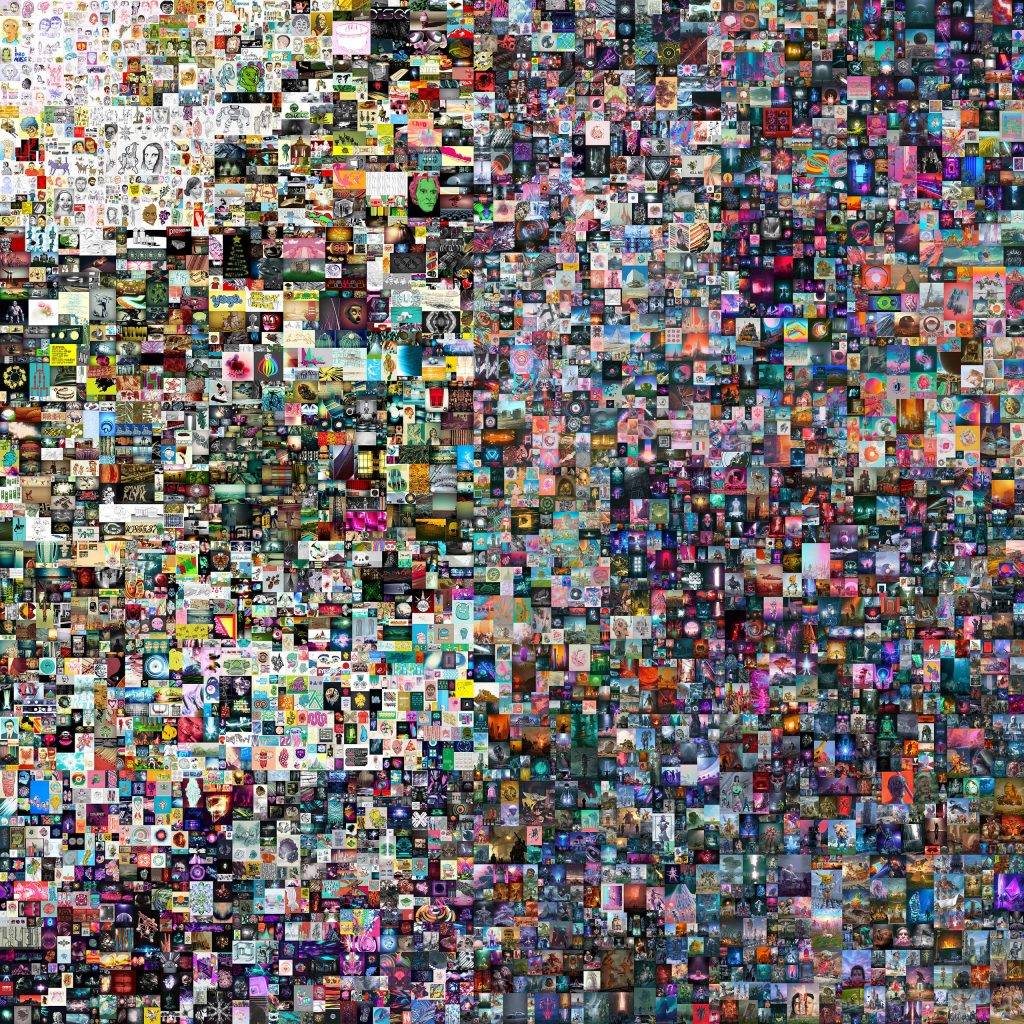
Image: Beeple
Application of NFTs
Digital Art
The Beeple example shows how NFTs can be used to promote digital artwork. Along with that there are multiple exchanges setup where any artist can auction their artworks in form of NFT. OpenArt, SuperRare and Pixura are few examples
Digital Assets
There are a lot of digital assets beyond artwork which can be tokenised and stored on a ledger.
Etherium Name Service (ENS) is one such example, it sells crypto addresses in the form of myname.eth. These are similar to usernames of Instagram or twitter and can be bought and sold in marketplace.
Decentraland – It is a shared virtual world where users can buy, develop, and sell land in the form of an NFT. Each parcel of land is unique and owners get to choose what to do with it. Users can purchase land as well as all other goods and services in Decentraland. It is similar to the virtual world OASIS described by author Ernest Cline in Ready Player One.
Collectibles
Collectibles of digital goods is a popular use case of NFTs. Interestingly, online collectibles such as Cryptokitties were one of the earlier ways in which people learnt about the use of NFTs.
Cryptokitties is a game where users can own and breed digital kittens. Each crypto kitty has specific traits such as fur pattern or eye color, making them unique. Users can purchase two different cats, a Sire, and a Dame, and breed them by simply clicking on a button. The resulting new kitten features its own identity and Genetic Algorithm or GA. The scarcity of genetic makeup determines the value of crypto kitties.
NBA Top Shot – USA’s National Basketball League (NBA) extracts highlights from basketball match and puts them into digital packs, just like traditional cards. These packs sell at a price range, depending on the quality of the highlight and the player. Upon buying, these highlights go into a buyer’s encrypted, secure highlight wallet. These cards can also be traded on online marketplaces.
Sports
NFTs can be used to remove counterfeit tickets sold for sports events by providing an easy way of authentication. Additionally, the tickets sold in black could also be limited as the owner can be marked for each ticket.
Fashion
The fashion industry could also benefit from NFTs. Consumers can easily verify the ownership information of their items and accessories digitally, which would reduce the risks of counterfeiting frauds.
Nike holds a patent for a blockchain-based sneakers called ‘CryptoKicks’. As per the patent, when a consumer buys a genuine pair of these shoes, a digital representation of a shoe will be generated, linked to the consumer, and assigned a cryptographic token. The digital shoe and cryptographic token collectively represent a ‘CryptoKick’. When sneakers are sold to someone else, ownership can be transferred by trading both real shoe and/or associated digital assets. These digital assets can then be stored in what’s being called a “Digital Locker,” a cryptocurrency wallet type app.
Certifications
Certificates are offered by various establishments like Universities, Institutes, online learning platforms and even employers in digital or paper based form. These certifications are required by different organizations like potential employers, banks, and visa offices. Licenses are also used to give some kind authority to the holder and are functionally similar to certificates.
Administrations could save a lot of time by using NFT to access such certificates and/or licenses with the functionalities of NFTs. NFTs take away the burden of record checking and verification. Subsequently, they provide an easier approach for storing evidence of course completion or licensing.
Identity Theft
Official identity documents such as medical records can be digitized using NFTs to prevent identity theft. Furthermore, artists can also use it to convert their physical works into a digital format and establish claims on their creation. A budding screenwriter can tokenize their script and store it on ledger to claim the title of original script writer.
Wrapping Up
Converting any digital data to NFTs can be useful as the ownership can be certified. NFTs are also unique, indivisible and thus scarce in nature. There are multiple applications of NFT ranging from digital arts to storing certificates. In essence, any application where digital goods are involved and ownership is required can involve the use of NFTs. Let me know in the comments box if you can think of any use case for NFT.
 Hitesh Gulati, CFA