Short Straddle Strategy – NIFTY50

 ₹ 71,962. This is the amount Short Straddle Strategy could make in three months if one is willing to engage a capital of ₹ 7,00,000. Seventy thousand rupees in three months on seven lakhs makes a monthly return of 3.4% and an annual return of 40%. I know, you would say 40% return that sounds crazy to that I would add: It’s not crazy its ridiculous. Let me try to breakdown the whole process.

What are we doing?

In short we are selling options.

A option is a contract between two parties Seller and Buyer. Seller sells the option contract to Buyer for a few bucks. In return buyer gets an option to buy a share of a company at an agreed upon price on a predetermined date.

Say Sameer the seller sells Bobby the buyer an option contract that Bobby can buy share of Reliance Industries Limited from Sameer for ₹ 2,600 on 28th Oct. On 28th Oct, it will be Bobby’s choice to buy the share or not. If Reliance would be trading at more than ₹ 2,600, Bobby will be interested in buying it from Sameer @ ₹ 2,600. While if its less than ₹ 2,600 Bobby can ignore the contract. Sameer on other hand will be obliged to sell the shares if Bobby chooses to buy. If Sameer doesn’t have Reliance’s share with him, he will have to buy it from market and sell it to Bobby @ ₹ 2,600. And yes even if he bought it at a higher price and thus making a loss in the whole deal. Seems like Bobby has a big advantage in this options contract and this is because options are designed to favour the buyer. In that case what in the contract for the seller? Well while initiating the contract Seller will ask for an upfront payment. So in our case Bobby will have to pay an amount say ₹ 50 to Sameer upfront and when the day comes may or may not exercise the option.

We in our Short Straddle Strategy take Sameer’s position and sell options contract on Nifty. Why selling options and not buying and Why Nifty? Let’s cover that in next segment.

Why we sell contracts?

We know options contract are designed to favour the buyer but in reality the compensation seller gets makes the contract a fair deal for both. Consider current prices, Reliance last traded at ₹ 2520 and an option to buy Reliance at this price on 28th Oct was sold at ₹ 84. So let alone the decline in Reliance’s share price, even if the price remains same for the whole month, seller stands a change to make ₹ 84. This is a pretty good deal for the seller. If the share price goes down, seller makes money. If the share price stays same, seller makes money. If the share price goes up a bit (but not much), seller still makes money. Buyer only makes money when share price goes up drastically.

Although it happens seldom that buyer makes money on an option contract, but when that happens they make huge money with a potential to destroy seller in one go. So how can a seller safeguard themselves from such huge blows? This is why we trade in NIFTY, let’s cover that in next segment.

Why we sell NIFTY contracts

NIFTY contracts are the most liquid options contract on the exchange. This means at any given time maximum number of traders are willing to buy/sell NIFTY contracts than any other contract. Open interest is a good metric to judge liquidity, higher the open interest higher the liquidity. Open interest for NIFTY options is around 15000 while highest open interest for Reliance’s options is just 4000.

Seller can limit their losses by offloading current contracts to another seller by take a small loss. In our earlier earlier example Sameer sold an option to Bobby for ₹ 50 to buy Reliance share at ₹ 2,600 on 28th Oct. If Sameer feels Reliance price will shoot up drastically and he would end up making a big loss, he can offload the contract to another seller by booking a small loss in his books. This offloading will be possible only if there are sellers available to be offloaded. NIFTY having liquidity ensures this.

How we implement the strategy

The NIFTY index moves throughout the day, it has its high points and low points before the trading day closes. In the short straddle strategy we try to enter a position where NIFTY is within our grasp. If the the index moves out of grasp, we alter our position to re grasp it. We continue to play the game of taming the bull until the index settles. During this game the longer we hold our grasp more money we make and we loose money altering our positions.

In order to limit the losses we also keep a track of profit or loss we are at for the day. If the loss incurred is more than our limit, we quickly offload our positions to another seller by booking the loss and exit the market.

We take following steps int he strategy:

  1. Check the Latest Price of NIFTY
  2. Decide if the current position is good or we need to alter it
  3. If altering the position, decide the new position
  4. Track profit or loss we have booked
  5. If the losses are beyond our limit exit the market

We keep on repeating these steps and take decisions accordingly. In the end it becomes the game of taking quicker actions, if the index price went too far quickly adjust the positions, if the loss are too high quickly exit the market. In fact faster we are able to repeat these steps more efficient we become and more profit we book. It’s not humanly possible to run these steps fast enough and thus we designate a dedicated computer for it. Due to faster processing we are able to repeat these steps every second.

By analysing the market every second we ensure the index doesn’t move too far for us to not be able to handle the shift. Or by tracking losses every second we ensure the moment we hit our loss limit we are out of the market the very next second thus not experiencing soared losses.

Back to the Interesting Stuff

We backtested the Short Straddle Strategy on NIFTY for three months 17th May 2021 to 13th August 2021.

The capital required for the strategy is ₹ 7,00,000. We need to have this amount in our account to be able to run the strategy.

We set our max loss per day limit to ₹2,000. This means moment we hit loss of ₹ 2,000 we exit the market. The actual loss might come to around ₹ 2,500 for some days.

On Tuesday, June 1st 2021 we incurred a loss of ₹ 2,235. This was our max loss during the entire period.

On Thursday, June 24th 2021 we made a profit of ₹ 9200. This was the max profit we made during the period.

On average we made a profit or ₹ 1,124 daily.
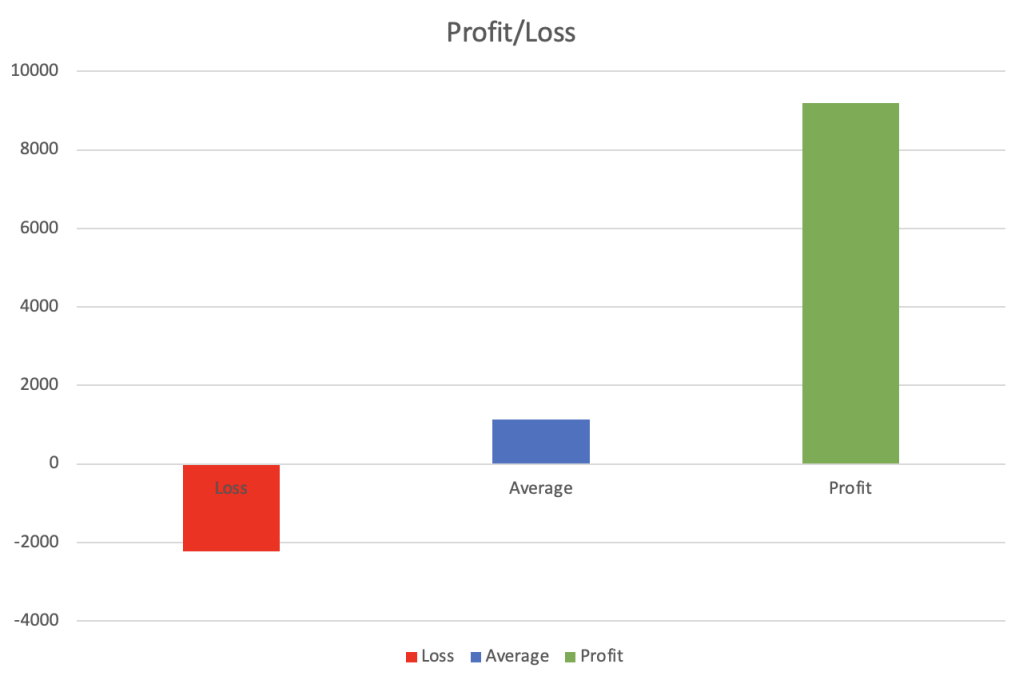
Out of total 64 trading days, we made profit on 43 days while loss on 21 days. On the days we made profit we made average of ₹ 2,508 while on loosing days we lost ₹ 1,710.

There were days when the index movements were at peak.

  • On Monday, June 21st 2021 NIFTY moved up 220 points, we made a profit of ₹ 3,982 that day.
  • Two days later Wednesday, June 23rd NIFTY fell 175 points. We lost ₹ 2,000 that day.
  • On Tuesday, August 3rd we were on track to make a big loss of ₹ 4,282. But to due our max loss mechanism our losses were limited to ₹ 2,047

We usually make money when we hold our position for long. Thus on an average we make a loss to get a hold on position. Once the index movements slows down we start to book profits. Again mid day our profits become stagnant but towards the end of the day we make big leaps.

This has been a brief analysis of the Short Straddle Strategy when run of NIFTY index. The Short Straddle is amongst the most basic options selling strategy and is wide known. Even with huge popularity this strategy is able to deliver amazing returns, tis is possible because a) There is still huge potential in the market for options selling and b) Use of efficient processing, the faster we process the better results we get.

Please get in touch with us for a detailed analysis of the strategy.

Disclaimer

  • The results presented are based on backtest we conducted on the NIFTY options
  • We have assumed market to be highly liquid, which might not be absolutely true in real scenario
  • We have not incorporated brokerage charges as it differs from one broker to another. Besides the brokerage charged by discount brokers are nominal compared to the gains mentioned.

How does bitcoin / blockchain work – Part 2

All four Aditi, Bobby, Chetan and Deepa meet again.

Aditi: Did you guys got enough time to think about our discussion?

Chetan: Oh definitely, last time that was big. I mean we should have made some notes.

Bobby: Don’t worry, I met Hitesh later that week and told him about our discussion. He wrote a blog about it and covered it quite well.

Go to https://hiteshethos.wordpress.com/2021/07/31/how-does-a-bitcoin-blockchain-work/ for a recap.

Chetan: Thanks for that. I now remember we ended our discussion by creating a block chain. I also remember a concern I had after our meeting.

Deepa: Yeah shoot it.

Chetan: So we said that whenever a transaction is broadcasted, we will be choosing a gatekeeper. Who is choosing this gatekeeper? I mean the one choosing the gatekeeper becomes  way to powerful and should be trusted by all members.

Bobby: No, I am not in favor of giving one person the responsibility to choose the gatekeeper. We’ll need to have an algo based on which a gatekeeper will be allocated every time there is a transaction.

Deepa: I agree, having an unbiased algo should be in place.

Aditi: How about we select someone at random?

Bobby: That would be a good start. But I can think of one problem with random selection.

Aditi: Sure, go ahead.

Bobby: Let me explain it by an example. If I am selected as a gatekeeper for a block and I want to make a fraudulent transaction in it. What’s stopping me to do that? ‘I don’t know who the next gatekeeper will be’, right?

Aditi: I think yes, but please can you elaborate it a bit?

Bobby: So in order to have make a fraudulent transaction, as a gatekeeper I will send out the correct set of transactions to say Deepa and Chetan, but fraudulent set of transaction to Aditi. I wont be caught while doing this. But during next transaction when a new gatekeeper comes in they will broadcast new transaction but will also broadcast link to previous transaction (the one I broadcasted) and I will be in trouble. If the new gatekeeper is from Deepa or Chetan, the linked transaction will be the correct one and Aditi will raise the alarm, if the new gatekeeper is Aditi, the linked transaction will be the fraudulent one and both Deepa and Chetan will raise the alarm.

Aditi: Yes, I get it now. Because you don’t want alarm to be raised against you, so you wont try to make a fraudulent transaction.

Bobby: Exactly. Now what if I, Chetan and Deepa collude. While I am the gate keeper and send a fraudulent transaction to you, there are pretty good chances that next gate keeper will be from me, Chetan and Deepa and not Aditi. In terms of probability it we’ll have 75% chances of being the gatekeeper. So having the probability stacked with us, we will keep on broadcasting the fraudulent transaction to Aditi with a chance. Later after certain number of transactions even if Aditi gets to be a gatekeeper, it would be too late to raise the alarm.

Aditi: That means a probability of above 50% is dangerous.

Bobby: Yes, if the colluding parties have less than 50% chance of being the next gatekeeper the system should run fine.

Deepa: I get your point, but we wouldn’t collude in first place, right?.

Bobby: We won’t collude because we trust each other. But remember we want to remove the trust requirement from the system. If we open our system to all, what is stopping me to add five new accounts as new members and I’ll have 66% (6 out of 9) chance of being the gatekeeper every time.

Chetan: Ok I got your point. What if we do other way around. We’ll give everyone the opportunity to be a gatekeeper every time.

Aditi: But then who’ll select the gatekeeper?

Chetan: We will design an algorithm which will pose a quiz for all to solve, the one who solves the quiz fastest will be the gatekeeper for that block.

Deepa: A quiz? Like a GK quiz?

Chetan: We no, we have math to our rescue here again. We can use hash function, these functions are difficult to answer but very easy to verify the answer.

Deepa: So you mean to say the one solving these functions will take brain power or computational power but others can just verify the answer quickly and accept the transaction block.

Chetan: Yes.

Bobby: But again what’s stopping me to add new fake accounts?

Chetan: Even if you add multiple accounts, you’ll still have same computational power. Which means adding new account wont increase your chance of being the gatekeeper but adding more computational power would.

Bobby: And doing that means buying more laptops which is a costly affair.

Chetan: Exactly.

Deepa: I guess we can stop here I can’t think of a loop hole for now.

Bobby: Yup, neither can I.

Aditi: Wow! You mean to say we are ready to add Esha to the system?

Deepa: Yeah, seems like we are ready to open our doors to public.

How does a bitcoin / blockchain work?

What is a Bitcoin?

The most common definition of Bitcoin that floats around is “Bitcoin is a fully digital currency with no government to issue it and no banks needed to manage accounts and verify transactions.” This is sufficient for most of the people interested in trading it or use it in some form or other. For them Bitcoin is like PayTM, they have money stored in their wallets which can be transferred or withdraw when required.

That said, some of the curious minded ones might want to go a little further. How a currency wallet might exist without a backbone in form of government to back the currency (Rupees in this case) or PayTM to verify transactions. In order to understand how bitcoin works, let’s look at a story of four friends, how they transact among each other and how they might end up inventing their own version of blockchain.

Story of four friends

Aditi, Bobby, Chetan and Deepa are four friends, and they transact among each other frequently like paying their share of dinner bill or splitting other group expenses. Their transactions look like:

  • Aditi pays Chetan ₹ 20
  • Deepa pays Aditi ₹ 10
  • Bobby pays Chetan ₹ 30
  • Chetan pays Deepa ₹ 50

There can be large number of transactions and thus instead of exchanging real money every time they decided that everyone will log these transactions on a spreadsheet maybe an excel sheet, a google sheet or a plain old register. Anyone can announce a transaction and all the friends update that in their own spreadsheet. In accounting terms this spreadsheet containing list of transactions is also called ledger.

In the end of the month, they net all the transactions to calculate balances and settle by paying in real money.

On one of the settlement-days they all met on dinner.

Chetan: “We have been using this for quite a while now and it has been near perfect solution to exchanging money all the time.”

Bobby: “Oh, I’ll tell you, this has been a life saver. Exchanging money all the time is really cumbersome.”

Aditi: “You know, I was taking about this system with my close friend Esha, and guess what, she is also interested to join in. If she joins we’ll be able to transact with her as well. Isn’t that great?”

Deepa: “But she can’t join in”

Aditi: “Why so?”

Deepa: “Because we don’t trust her, and the whole system works when all the participants mutually trust each other. Which means for her to enter all of us must trust her and she should trust all of us.”

Aditi: “What do you think can go wrong?”

Bobby: “I agree with Deepa trust is really important. We all trust each other to announce or broadcast which is a better term, only valid transactions. For instance, if I say, ‘Deepa pays Bobby ₹ 50’, you all trust me that it’s a valid transaction and thus log it in your ledgers.”

Aditi: “You mean to say Esha would broadcast fraudulent transactions all the time?”

Bobby: “I am not saying she would, just that it’s a possibility. There is nothing stopping her from broadcasting say ‘Deepa pays Esha ₹ 50’ or ‘Aditi pays Esha ₹ 50’ every once in a while. Again, not doubting Esha but my point here is before bringing in a non-trusted entity we need to ensure that our system is full proof and as of now it is not.”

Chetan knows something about digital signatures and chips in, “I agree with you, that’s a possibility. But to safeguard our system how about we do this, whenever there is a transaction broadcasted it should be accompanied with sender’s digital signature. So, in case ‘Deepa pays Esha ₹ 50’, Deepa should add her digital signature to the message and then it can be sent to anyone. Additionally, everyone will verify the sender’s signature before updating the ledger. Any transaction without signature will be discarded, thus no one will be able to generate and broadcast fraudulent transaction.”

Bobby: “You mean like a bank cheque, where the sender’s signatures are verified before making the transaction?”

Chetan: “Exactly, but we’ll be using digital signatures.”

Deepa: “That would be a nice feature addition. Although I am still not convinced. Even if all the transactions are valid what’s stopping any one from defaulting. If Esha owes me ₹ 50 say at the end of the month what if she doesn’t up on the settlement day, how will I get my money back?”

Aditi: “Well I can pay, but I get your point we’ll have to make the system default proof.”

Bobby: “I guess that’s rather simple. How about we chip in some money at the start of the month say ₹ 100 and keep updating the balance every time. On every transaction we first check the balances and only if the balance is more than the transacted amount, the transaction will be accepted.”

Deepa: “You mean to say if I started with ₹ 100 and I paid ₹ 70 Chetan, my balance will be updated to ₹ 30. At this moment if I broadcast a transaction ‘Deepa pays Bobby ₹ 40’, this won’t be accepted as my balance is only ₹ 30.”

Bobby: “Yes, thus preventing overspending.”

Aditi: “I think that’s a must. Stretch your legs only as far as the blanket allows.”

Deepa: “I agree!”

Chetan: “I think that’s brilliant. If implement this, we can totally eliminate the need to settle and probably transact till eternity.”

Deepa: “I don’t get that.”

Chetan: “Think of it in this way, we settle at end of every month because it’s convenient for everyone. Now if everyone chips in before start transacting the money will always be in the system and to settle my account, I just need to interact with the system which I can do anytime. Because I am sure I can settle with the system anytime I might even choose not to settle at all.”

Aditi: “I get it. It’s like a bank account. I know my money is safe in the bank account and I can withdraw it anytime I want. Although I have the options to settle the balance with my bank by withdrawing all the money at end of the month, I prefer not to do that and instead just check the balance once in a while.”

Chetan: “Thanks, you put it even better than I even though off.”

Aditi: “Thanks. If I may take it even a step further, we can stop call it Rupees after all. I mean if I don’t intend to withdraw the money from the system, I may start calling it Ledger Money instead. Or even more fancy, Bitcoin”

Chetan: “I like that idea of a different currency, as long as we transact among ourselves, we can call it anything. Though let’s stick to Ledger Money. Bitcoin is too fancy for me, if I’d like fancy, I will rather change my name first, Satoshi seems a good option.”

Bobby: “That’d be cool. We’ll design a new logo for it too.”

Deepa: “Hold your thoughts. I am still not convinced. I don’t think its full proof yet.”

Aditi: “What are you thinking?”

Deepa: “I am not sure but what if someone instead of broadcasting the transactions sends selective messages to each user.”

Aditi: “Try that with an example again?”

Deepa: “Yes. So, let’s say Esha has to pay ₹ 50 to Deepa, she drafts and signs ‘Esha pays Deepa ₹ 50’ send it to everyone except Chetan. She drafts another message ‘Esha pays Deepa ₹ 20’, signed and sent to Chetan.”

Chetan: “So you are saying everyone updating their ledgers is not a good idea? How about we designate someone as a gatekeeper. Gatekeeper will be verifying and maintaining the register and others will just copy the content from them.”

Aditi: “That seems like an easy solution.”

Bobby: “No it’s not that simple, all the parties will have to trust the gatekeeper. This brings us back to square one, if the system requires trust to function, then it’s not a full proof solution.”

Aditi: “How about we keep on changing the gatekeeper.”

Bobby: “I think that might help, but can you elaborate how?”

Aditi: “OK, if same person remains the gatekeeper, they will have the power to validate transactions and might misuse use it, which is where trust comes in right?”

Bobby: “Yes.”

Aditi: “Now hear me out on this, what if we choose a different gatekeeper for every transaction or set of transactions. Say when a transaction is broadcasted, a gatekeeper will be chosen. The selected gatekeeper will validate transaction and then rebroadcast the validated transaction. Others will confirm the previous transact update their ledger only when a validated transaction is broadcasted. Along with current transaction link to previous transaction will also be broadcasted for others to detect fraud if any. Next transaction there will be a different gatekeeper who will do the above tasks to validate the next transaction.”

Bobby: “So if I get you correctly you are saying whenever there will be a transaction, following steps will be followed:

  1. Sender of the transaction will sign off the transaction.
  2. Any member can broadcast it.
  3. A gatekeeper will be chosen.
  4. Gatekeeper will validate the transaction
    1. Verify signatures
    2. Confirm there is no overspending
  5. Attach a link to previous transaction
  6. Add their own signature to confirm its validated
  7. Rebroadcast the validated transaction
  8. Other members when alerted with a validated transaction will:
    1. Confirm previous transaction is as per their ledger
    2. If yes add current transaction to their ledger
    3. Raise an alert in case of a mismatch
  9. All wait for new transaction.

Aditi: “Wow! Thanks for putting it all together. So yes, if a gatekeeper say Esha does all the required steps and sends a transaction ‘Esha pays Deepa ₹ 50’ to everyone but sends a different transaction ‘Esha pays Deepa ₹ 20’ to Chetan. It won’t be suspicious as of now, but during the next transaction say Bobby is the gatekeeper, he’ll do all the required steps and link previous transaction which is ‘Esha pays Deepa ₹ 50′”

Bobby: “And the moment Chetan hears ‘Esha pays Deepa ₹ 50’, he’ll speak up that the last transaction he received was incorrect and Esha the gatekeeper of last transaction will be questioned.”

Aditi: “Gosh! You nailed it.”

Chetan: “Oh dear! Let me wrap my head around it once again. We will a take a transaction or bunch of transactions and choose a gatekeeper. The gatekeeper after validating all the transactions, will create a block and add to it:

  1. Link to previous block
  2. Validated transaction
  3. Their own signature to confirm it is validated

This block will then be broadcasted. Upon receiving the block everyone will confirm previous transaction and if it’s not as per their records they will raise an alert. In essence each block being linked to previous block will create a chain which will help detecting any fraudulent transactions.”

Aditi: “We can call it blockchain.”

Deepa: “Wow! This discussion is turning out to be really ‘Momentous’ if I may say. I won’t be surprised if someone write about it in future.”

Chetan: “I guess we might be able to include Esha after all.”

Aditi: “I know, but let’s give ourselves some time to digest all the information. Maybe we will discuss it further in the next settlement dinner.”

Wrapping Up

Aditi, Bobby, Chetan and Deepa have a well-functioning transactions system in place, but it run on trust. Introducing a non-trusted member will break the system. Their goal is to make the system full proof so that trust is no longer required in the system. The add different features to remove trust requirement at each stage. Digital signatures prevent fraudulent transactions, adding money before transacting prevents overspending, and finally a gatekeeper and chain of blocks helps fraud detection. These friends are on the path of discovering their own blockchain but are just one step short. Remember they choose a gatekeeper to validate a block, how this gate keeper will be chosen is another question and no they can’t just choose randomly. But as Aditi said let’s discuss it further in the next monthly dinner.

Smart Contracts, an explanation with examples

Introduction

In 1996, Nick Szabo, a computer scientist, and an early cryptocurrency pioneer described smart contract as “a set of promises, specified in digital form, including protocols within which the parties perform on these promises” (Szabo, 1996).

That definition is everything I don’t understand about law combined with everything I don’t understand about computers. So let me try to break it down and talk in plain English from now on.

Contract

Let’s start with a contract. Larry Lessig, a Harvard Law School professor, describes a contract in plain English as:

promise or performance

given in exchange of

promise or performance

This definition maps out four different possibilities:

  1. A promise in exchange for a promise: I promise to pay you ₹ 1,000 if you promise to sing a song for me tomorrow. Both the actions will happen in future but both parties are binding themselves by the virtue of promise.
  2. A promise in exchange of a performance: I promise to pay you ₹ 1,000 if you sing a song now. Note that I am not interested in a promise, I want the actual performance now.
  3. A performance in exchange of a promise: I’ll sing if you promise to pay me ₹ 1,000. I will perform now on your promise to pay me later.
  4. A performance in exchange of performance: I’ll sing a song if you dance on it. I’ll perform and I expect your performance simultaneously.

The given in exchange for part is also critically important, it sets the quid pro quo context in the arrangement. I cannot ask you to sing a song without any consideration from my end, it can be asked as a favor but not as a part of contract. However, we can have a contract that I’ll pay you ₹ 1,000 to sing a song. In this case, both the parties will be obligated to honor their respective commitments.

Smart Contract

Coming back to the smart contract let’s look at the definition and try to break it down in plain English:

 “1a set of promises, 2specified in digital form, 3including protocols within which the parties 4perform on these promises”.

1A set of promises: These are the promises each party in the contract agrees to deliver upon. All parties will be required to honor their end of commitment and if not honored it will be considered as breach of contract.

2Specified in digital form: A typical contract is a form of a document. This document contains all the terms and conditions drafted in a widely used language and are agreed by all the involved parties by way of signing it. A smart contract however is in digital format and operates electronically. All the terms and conditions and even the outcomes are embedded in lines of code in a computer readable language (eg Solidity). Although most smart contracts would have an assisting whitepaper describing the process in English but lines of code is the source of truth.

3Including protocols: These are the protocols each party needs to adhere to while interacting with the contract. A contract can have many features, the protocols will define how those features can be accessed.

4Within which the parties perform: All the activities including performance are recorded in digital format. These performance may include transfer of money, transfer of goods, rendering of service and many others, all of these needs to be as per the protocols, recorded and stored within the contract in digital form. Some promises like promise to pay certain amount can also be automated to limit human intervention to ensure commitment.

Examples

Let’s look at three examples of contract and how they operate:

1. Share allocation in an IPO through ASBA – A traditional contract

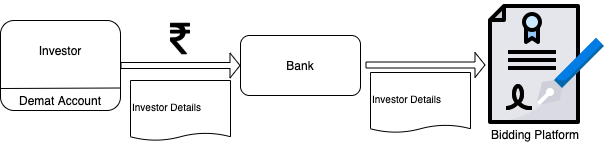
Initial Public offering is a process when a company decides to issue its shares to public for the first time, this is also referred as ‘going public’. People (Investors) interested in investing in company’s shares can bid for same on a bidding platform. This is a promise given in place of a performance. Investors promise to pay the bid amount if the bidding platform allocates the shares to them. The platform on other hand runs a risk that applicant might not have the capability to pay if shares are allotted. To reduce the risk a trusted third-party is involved in the contract – Banks. Investors need to send an application to their banks along with their bid amount. This application is known as ‘Application Supported by Blocked Amount’ (ASBA). Banks then compiles the list of investors and their details (like PAN, bid amount, etc) and send it to the stock exchange.

Share allocation in an IPO through ASBA

The actual process is divided into two steps:

i. Application

Application to bidding platform

Investor submits the ASBA form to the bank and adds the bid amount to their bank accounts. In turn, the bank send investor’s bid with details to the bidding platform. Banks also blocks the bid amount in investors’ account.

ii. Allocation

Allocation of shares

At the time of allocation, the bidding platform allocates share to an investor i.e. transfer shares to investor’s demat account and bank transfers the bid amount (₹) to the bidding platform.

Adding banks as an intermediary converts the contract from promise in place of a performance to performance in place of performance. This benefits both the parties in the following manners:

For Bidding Platform: Platform trusts banks to ensure investors payment capacity and thus investors without having actual fund cannot enter the bid.

For Investors: There is no need to pay upfront. The amount submitted along with the ASBA form is blocked in investors account but never leaves the account.

2. Lottery – A sample Ethereum Smart Contract

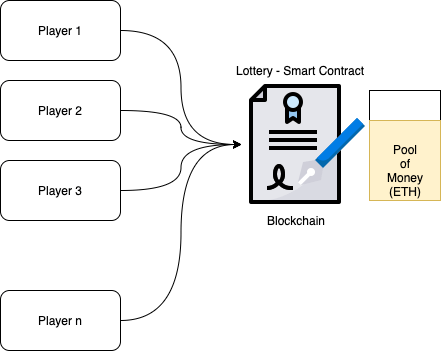
Lottery is a sample of a simple smart contract on Ethereum blockchain. This is like a real-world lottery system where n number of people can enter the lottery paying a minimum amount of money (Ether, a crypto currency like Bitcoin in this case). All the money collected is stored within the system in pool of money. This is a sample of performance given in place of a promise.

Lottery smart contract overview

This smart contract has two functionalities:

i. Entering the Lottery

Players can enter the lottery by transferring a minimum of 0.01 ETH (Ether) to the contract. Any player who tries to enter the lottery by transferring amount less than 0.01 ETH will be rejected. Once the amount is verified and approved players name or a unique identification (ID) will be stored in the contract and the amount transferred will be added to the pool of money within the contract.

Entering the Lottery

ii. Winner selection and declaration

After a pre-defined period, manager (the person who created the contract) will initiate winner selections process. The winner will be selected randomly from list of all the players in the lottery. Although manager initiates the selection, they can’t select the winner of their choice, it will always be a random process. Also, only the manager can initiate the selection. Once the winner is selected all the money available in pool of money withing the contract will be transferred to winner’s wallet.

Winner selection and declaration

The Lottery contract have all the properties of a smart contract:

  • a set of promises – Players entering the contract performs by paying the minimum amount, while contract promises that the lottery winner will win all the money collected.
  • specified in digital form – The whole contract is defined in form of a lines of code written in a computer readable language, Solidity. There might or might not be a supporting white paper to describe the contract but the code will serve as the source of truth. This means, all the parties cannot just rely on the whitepaper to describe the contract. If there is something coded in Solidity but interpreted differently in the white paper, the computer code will considered as correct. The code snippet is attached at the end of this article for the interested ones.
  • including protocols – The contract have following properties
    • manager – Every lottery will have a manager. A manager is the one who initiates the lottery contract.
    • Enter() – Using the enter feature, anyone can ether the lottery by depositing minimum 0.01 Ether into the contract. This money will be stored in the pool of money and players name will be stored in a list on contract. Anyone trying to enter the lottery depositing less than 0.01 ETH will be denied.
    • pickWinner() –  This feature will select one player from the list of players randomly and transfer all the collected funds to the winners wallet. Only the manager can initiate this feature, if anyone else requests this, the request will be denied.
    • within which the parties perform on these promises – All the promises, performances and features related to contract should exist on Ethereum Blockchain. The transactions like adding money to pool when someone enters the lottery are recorded on blockchain. Some transaction like transferring all the money in pool which are ensured by the contract are automated.
Lottery contract protocols

Although the players must pay upfront to enter the lottery, the money is going to the contract and not the manager. Manager cannot just take all the collected money and run away as there is no protocol for that. Thus, the Lottery smart contract ensures trust without involving a third party.

Using the Lottery contract as base, many more features can be added to make the contract more complex and serve more applications. The contract can be extended to different periods and ensuring there are no repeat winners until all have won at least once, this contract can serve as a Kitty Party Contract. Similarly, this can also be converted into a committee contract or poker contract to manager poker chips.

3. The DAO – A Decentralized Autonomous Organization smart contract

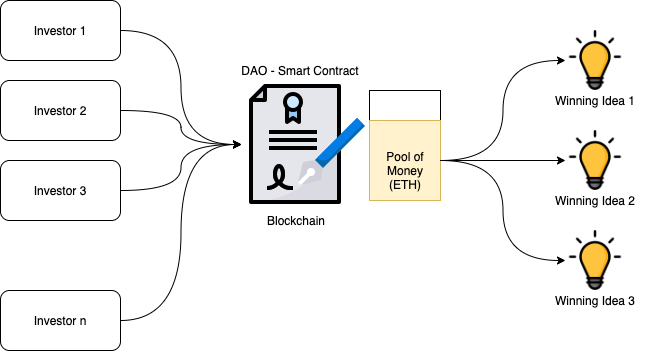
The DAO was an actual smart contract that existed on Ethereum blockchain and was written in Solidity. The DAO was launched on April 30th, 2016, and aimed to be an investor directed venture capital fund. The core functionality of DAO was that people from all over the world will pool their money into a venture capital fund, which will be used to fund smart contract-based ideas. There will be no director or fund manager and instead investors will decide which smart contract to fund. Each investor will vote, and the highest voted idea will be funded. This process will be repeated to fund various startups. The value generated from these funded smart contracts will be distributed among investors of DAO.

DAO smart contract overview

There were three core functionalities in the contract:

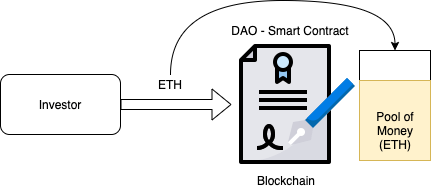
i. Entering the Fund

Entering the Fund

ii. Voting for the ideas

Voting for ideas

Different ideas will be pitted against each-other, and investors will vote for their favourite ones. The idea with highest number of votes will be declared as the winner.

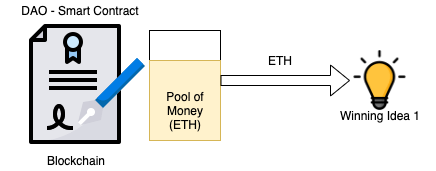
iii. Funding the ideas

Funding the ideas

The winning idea gets the go ahead and all the ether collected in the pool will be transferred for its development. Further the value created from these ideas will be distributed among the all the investors whose money was used for the funding.

iv. Opt out provision

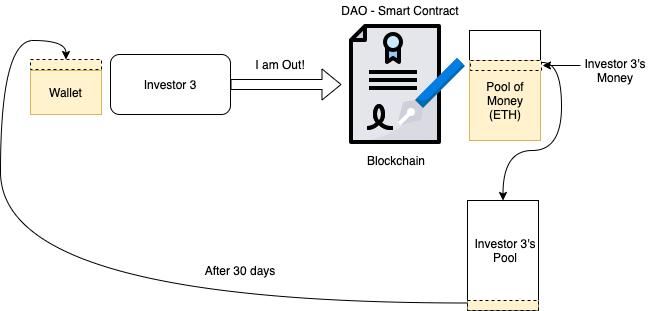
The investors who didn’t vote for the winning idea will be the minority and among these there might be some investors who won’t want their contribution to be used for funding of the winning idea. For instance, Investor 3 in previous voting illustration didn’t vote for Idea 2 (the winning idea) and would prefer to opt out instead of funding idea 2 from their part of the pool. To keep the interest of such minorities, opt out feature was added.

Opt out provision

In the opt out feature, any investors who wants to opt out of the contract can take their money out of the collective pool and after a defined period get the amount back in their wallet. Continuing from previous example, if an investor initiates the feature, it had following steps:

  1. Contract looks into the pool of money register to determine investor’s contribution.
  2. Contract then creates a child pool and transfers investor’s contribution into it. Investor 3 has exclusive voting rights for this pool.
  3. Contract updates the collective pool register by reducing the investor’s contribution to zero.
  4. The money stays in the child pool for 27 days. After that, investor can request to move the segregated money back to their wallet.

This way any investor can pull their contribution back from the contract and won’t be the part of the profit/loss sharing.

The DAO contract was launched on April 30, 2016, on Ethereum network and was a huge success. The contract invited investors to invest for a period of 28 days and attracted 1100 investors contributing 12.7 million Ether (~USD 150 million, at that time) to the contract. This was one of the largest crowdfunded campaign in the world. The contract held 14% of total ether circulated in the market by end of May 2016. The DAO had a dream start and attracted a lot of media attention which could have served as a good platform for future smart contracts.

However, on July 17, 2016, a hacker found a loophole in Opt Out feature of the contract. The code for opt out was written in a way that it transferred the money first (step ii) and updated the collective pool register later (step iii). The code exploited this vulnerability, they initiated the opt out request, code determined their contribution, transferred it to a child DAO and before code could update the collective pool register, hacker initiated the request again. In this way code was never able to update the pool register which means as per the pool register hacker still had their investment in the pool, even though in actual it was transferred to child DAO. When code was called again it transferred the same amount to again the child DAO, without updating the register. Hacker initiated the request several times recursively and was able to drain approx. 3.6 million Ether (~USD 50 million, at that time) from the DAO contract. The Ethereum community noticed this abnormal transfer from the DAO fund

In the open letter, the attacker claimed that code is law in the DAO and what he did was allowed by the code, thus, his actions were legitimate. The attacker continued by saying that “a soft or hard fork would amount to seizure [his] legitimate and rightful ether, claimed legally through the terms of a smart contract”.

The Ethereum community had 27 days to decide on whether to do nothing what the attacker wanted of do a soft/hard fork and return the funds to rightful owners. The community eventually decided to do a hard fork, which was completed by July 20, and funds were returned to the original investors.

Conclusion

A contract is a promise or a performance given in exchange of a promise or a performance. A well-structured contract will define obligations and expectations of all the parties involved. In order to reduce the risk that a party might not honor its obligation a trusted third party like banks/court/government can be involved as an intermediary like in IPO allocation example.

A smart contract is a digital form of the contract in which all the terms and conditions are defined by computer code. This digitalization enables parties to run the code on a blockchain which would eliminate the need of including a trusted third party in some of the contracts like in lottery example.

The smart contract considers code as the law, and thus all the involved parties must understand the code and its vulnerabilities to fully comprehend terms and conditions of the contract. In case there is a loophole, a hacker might attack the contract and since code is law, their actions will be considered as legitimate. This is why some consider a better term for smart contract should be ‘dumb contract’.

Appendix

The code for Lottery contract

contract lottery{
    address public manager;
    address[] public players;
    function lottery() public{
        manager = msg.sender;
    }
    function enter() public payable {
        require(msg.value > .01 ether);
        players.push(msg.sender);
    }
    function pickWinner() public restricted{
        uint index = random() % players.length;
        players[index].transfer(this.balance);
        players = new address[](0);
    }
    function getPlayers () public view returns (address[]){
        return players;
    }
    function random() private view returns (uint){
        return uint(keccak256(block.difficulty, now, players));   
    }
    modifier restricted() {
        require(msg.sender == manager);
        _;
    }
}

Non-Fungible Tokens: An Explainer

Non-Fungible Token, more popularly known as NFT, is a unit of digital data stored on ledger and is non fungible in nature. The data can be any digital ‘good’- a digital artwork, a video clip, a digital document, or a whole movie. Basically, any file which can be stored on a laptop or elsewhere can be an NFT.

The above definition didn’t make any sense to me first. So, let’s break it down by covering three different concepts:

  1. Digital data
  2. Ledger
  3. Non-Fungible

Digital data

Digital data can be product stored on our digital devices – smartphones, laptops, pen drives, cloud or anywhere. A picture stored on our phone, a pdf document sent on email, the email itself, last song we heard, a video clip shared on WhatsApp, an app on our smartphone, a game we play on a play station disk, the backup of our data stored over a cloud – ALL of them are different form of digital data. Anything from a small text to an entire system backup is a form of digital data.

Any type of digital file is a form of digital data

Ledger

A ledger is commonly used for record keeping. Let’s take the example of a ledger containing the list of all units of digital data with the names of their owners. This ledger has  two columns: Data and Owner. The data column will contain the data and owner will have name of the owner. It will look something like this-

Digital DataOwner
HelloHitesh Gulati
HiAastha Gupta
An extract of ledger containing list of digital data and its owner.

The above ledger states that Hitesh Gulati is the owner of the word “Hello”, while Aastha owns the word “Hi”. This table will be accessible to everyone and anyone across the world across the internet. Anyone can verify the ownership of the word “Hello” by looking at this table. Thus, this ledger certifies the ownership of a unit of digital data. This table can be stored in a central repository or over a blockchain, but it needs to be accessible to everyone to be effective.

Non-Fungible

A ‘fungible’ good is something which is interchangeable with other similar goods. An example of a fungible good is a currency note. If Person A lends a ₹ 100 note to Person B, then B can repay that with another ₹ 100 note or two ₹ 50 notes. It doesn’t matter if B returns the same note, since the value of each currency note is the same. This makes currency notes fungible.

A hundred rupees note is fungible, it can be replaced by another note, two fifty rupees note or even a bank transfer of hundred rupees.

Conversely, if A lends their car to B, it won’t be acceptable to A to get a different car even if it’s the same make and model, or even worse the same car but dismantled into body of car, engine, tyres and everything separately. This makes the car non-fungible. Thus non-fungible goods follow two rules:

  1. They cannot be replicated i.e. no two unit of same product can ever be completely same.
  2. They cannot be divided or clubbed i.e. two or more goods cannot be clubbed to form a third good.
A Car is non fungible. It can neither be replaced by another car nor replaced by providing each part but dismantled.

Now, let’s look at digital data in the context of fungibility. While digital goods can be of different types or applications, all digital goods are stored in the form of binary digits i.e.1’s and 0’s. The text “Hello” will be stored in the memory as a set of 48 binary digits: 01001000 01100101 01101100 01101100 01101111 00001010. Now if I alter the text from “Hello” to “hello” (with non-capitalized H), the binary digits will be: 01101000 01100101 01101100 01101100 01101111. Notice the change in first eight digits from 01001000 (in case of capitalized H) to 01101000 (in case of non-capitalized H or h). Thus, a machine recognizes both ‘Hello’ and ‘hello’ as different and unique from one another. Also, the text “Hello” is different from the combination of the text “He” and “llo”, just as an assembled car is different from a dismantled car.

Hello ≠ hello

Hello ≠ he + llo

Just like the text “Hello”, a larger file (like a picture) will also be stored as binary digits. Thus, all digital files are non-fungible. The binary digit value of any digital data is known as a token. So, the ledger above can be represented more clearly as Token and Owner.

TokenOwner
01001000 01100101 01101100 01101100 01101111 00001010Hitesh Gulati
The ledger containing token of word Hello and name of it’s owner

The token column will always contain unique token values. Thus, this ledger can verify that:

  1. Hitesh is the owner of token 01001000 01100101 01101100 01101100 01101111 00001010.
  2. No one else can own the same token, as the token value is unique (non fungibility).
  3. Two or more tokens cannot be combined to create what Hitesh owns (non fungibility, again).

Marketplace

Once the digital data is converted into an NFT and stored on a publicly available ledger, its ownership can be verified. These NFTs can now be bought and sold on NFT marketplaces. The owners can list their NFTs for sale, while buyers can verify the ownership of the NFTs and purchase them. Generally, the price is paid in normal currency and the ledger is modified to indicate change in ownership. If Vaibhav buys the digital word “Hello” from Hitesh the updated ledger would look like:

TokenOwner
01001000 01100101 01101100 01101100 01101111 00001010Hitesh Gulati
01001000 01100101 01101100 01101100 01101111 00001010Vaibhav Gulati
The record mentioning Hitesh as the owner will be removed and a new record acknowledging Vaibhav as owner will be added in the ledger

While NFTs are bought and sold in the marketplace it’s only the ownership which is transferred and not the actual good. In fact, the actual good may be stored elsewhere or even available to general public. Recently, Mike Winkelmann (Beeple-crap.com) a digital artist sold his artwork Everydays: The First 5000 Days in form of NFT for 69 million USD. This artwork is available in public domain. Anyone can view it, download it, use it as a wallpaper, print it and hang it on a wall but no own it (except the rightful owner). In essence, the owner just has the bragging rights to say, “I own that digital artwork” and the right to sell these bragging rights to someone else. It seems like a huge price to pay just for the bragging rights, when the product itself is available to millions of people to download. However, on the contrary as the popularity of the artwork increases, the price increases as well. Consider two different statements – “I own an artwork which is appreciated by hundreds of people”, and “I own an artwork appreciated by millions of people”. The latter one definitely has more value, and thus would cost more to claim.

Beeple’s collage, Everydays: The First 5000 Days, sold at Christie’s.
 Image: Beeple

Application of NFTs

Digital Art

The Beeple example shows how NFTs can be used to promote digital artwork. Along with that there are multiple exchanges setup where any artist can auction their artworks in form of NFT. OpenArt, SuperRare and Pixura are few examples

Digital Assets

There are a lot of digital assets beyond artwork which can be tokenised and stored on a ledger.

Etherium Name Service (ENS) is one such example, it sells crypto addresses in the form of myname.eth. These are similar to usernames of Instagram or twitter and can be bought and sold in marketplace.

Decentraland – It is a shared virtual world where users can buy, develop, and sell land in the form of an NFT. Each parcel of land is unique and owners get to choose what to do with it. Users can purchase land as well as all other goods and services in Decentraland. It is similar to the virtual world OASIS described by author Ernest Cline in Ready Player One.

Collectibles

Collectibles of digital goods is a popular use case of NFTs. Interestingly, online collectibles such as Cryptokitties were one of the earlier ways in which people learnt about the use of NFTs.

Cryptokitties is a game where users can own and breed digital kittens. Each crypto kitty has specific traits such as fur pattern or eye color, making them unique. Users can purchase two different cats, a Sire, and a Dame, and breed them by simply clicking on a button. The resulting new kitten features its own identity and Genetic Algorithm or GA. The scarcity of genetic makeup determines the value of crypto kitties.

NBA Top Shot – USA’s National Basketball League (NBA) extracts highlights from basketball match and puts them into digital packs, just like traditional cards. These packs sell at a price range, depending on the quality of the highlight and the player. Upon buying, these highlights go into a buyer’s encrypted, secure highlight wallet. These cards can also be traded on online marketplaces.

Sports

NFTs can be used to remove counterfeit tickets sold for sports events by providing an easy way of authentication. Additionally, the tickets sold in black could also be limited as the owner can be marked for each ticket.

Fashion

The fashion industry could also benefit from NFTs. Consumers can easily verify the ownership information of their items and accessories digitally, which would reduce the risks of counterfeiting frauds.

Nike holds a patent for a blockchain-based sneakers called ‘CryptoKicks’. As per the patent, when a consumer buys a genuine pair of these shoes, a digital representation of a shoe will be generated, linked to the consumer, and assigned a cryptographic token. The digital shoe and cryptographic token collectively represent a ‘CryptoKick’. When sneakers are sold to someone else, ownership can be transferred by trading both real shoe and/or associated digital assets. These digital assets can then be stored in what’s being called a “Digital Locker,” a cryptocurrency wallet type app.

Certifications

Certificates are offered by various establishments like Universities, Institutes, online learning platforms and even employers in digital or paper based form. These certifications are required by different organizations like potential employers, banks, and visa offices. Licenses are also used to give some kind authority to the holder and are functionally similar to certificates.

Administrations could save a lot of time by using NFT to access such certificates and/or licenses with the functionalities of NFTs. NFTs take away the burden of record checking and verification. Subsequently, they provide an easier approach for storing evidence of course completion or licensing.

Identity Theft

Official identity documents such as medical records can be digitized using NFTs to prevent identity theft. Furthermore, artists can also use it to convert their physical works into a digital format and establish claims on their creation. A budding screenwriter can tokenize their script and store it on ledger to claim the title of original script writer.

Wrapping Up

Converting any digital data to NFTs can be useful as the ownership can be certified. NFTs are also unique, indivisible and thus scarce in nature. There are multiple applications of NFT ranging from digital arts to storing certificates. In essence, any application where digital goods are involved and ownership is required can involve the use of NFTs. Let me know in the comments box if you can think of any use case for NFT.

Purchasing Power Parity in digital age

Introduction

Netflix is available in 190 countries. The benefits it offers – more than 5000 titles, available on click of a button, on a device your preference, in the best possible resolution.  It is the same across the world, still a user in India pays ₹ 799 a month, in US it’s $ 19.5 (₹ 1440), Germany € 15.99 (₹ 1420), UK £ 13.99 (₹ 1430) and Brazil R$ 45.9 (₹ 600). Someone in US with $ 20 to spare can either buy a Netflix subscription for a month or instead convert the dollars to rupees and buy almost two months of subscription. The fact that paying in rupees will get you greater value (in form of more number of subscription days) than paying in dollars makes rupee more valuable. Or to put it differently, a customer holding rupees will have power to purchase more goods than another customer with equivalent amount of dollars.

The concept in play here is Purchasing Power Parity (PPP), which means that different currencies have different purchasing power. As per PPP, a currency may be undervalued or overvalued. In the Netflix example, 1 $ is equal to ₹ 40 ( ₹799 / $ 19.5 = ~₹ 40), i.e., . While in reality, it is $ 1 = ₹ 73, which means rupee is undervalued when compared to dollars. But we cannot just say if a currency is overvalued or undervalued based on what Netflix decides to charge its customers. In fact, to calculate purchasing power of different currencies, various measures are tracked and collected, these are known as Penn World Tables and are maintained by the University of Groningen. They keep track of measures like GDP, Spending, Import/ Exports etc of economies across different years.

A unique and light-hearted approach which is simpler to understand is the Big Mac Index maintained by ‘The Economist’. Instead of tracking multiple prices of multiple goods and services globally, it just compares the price of the king of the fast-food restaurants, McDonald’s popular menu item ‘Big Mac’. Why Big Mac? Well for any goods or services to qualify for the purpose of PPP comparison, they should ideally meet two criteria: a) available in most countries, and b) represant item of what people actually spend money on. The Big Mac meets the first criterion quite well and does a pretty good job on the second. The McDonalds and thus, the Big Macs are available across the world with similar ingredients and attracts fast food lovers universally. Similar to Big Mac, the Netflix’s subscription also checks the first criteria and scores good points on the second. In fact, in today’s digital age, most of the digital products have similar characteristics globally and are consumed by major percent of country’s urban population. 

Data Preparation and Analysis

Let’s take a basket of goods and services which are popular products in today’s digital age. This basket contains three type of goods.

  1. Devices: Mobiles, Tablets, Laptops, Play Stations and Xboxes. These devices act as our portal to the digital world. Pick up a device, connect to Wi-Fi, and voila, you are connected to millions worldwide.
  2. Software: Microsoft Office, Adobe Creative Suits, Gmail, iCloud.After connecting to our devices, we use software to do our work, communicate with people, save our stuff and many other tasks.
  3. Content: Netflix, Amazon Prime, Spotify, YouTube, Apple Music. This refers to media content (movies, songs, videos etc.) that are used by users. The key difference between Software and Content is Content is dedicated digital consumption, while software has a much broader context to do stuff.

To understand the PPP, we tracked the prices of 14 different products (goods or services, list available at end of post) following under each of the categories in 17 different currencies. Using these prices, we compared the purchasing power of each currency to determine if it’s undervalued or overvalued.

Results

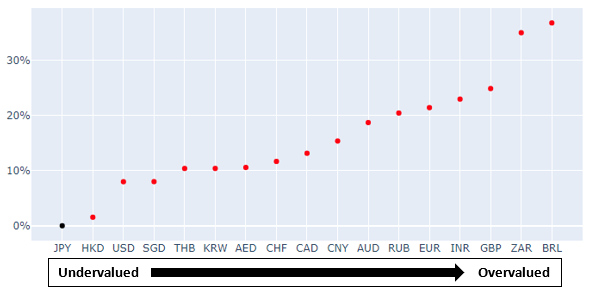
We compared currencies using prices of all three categories in the below chart.

  • A basket containing all 14 products will cost ₹ 3,90,000 in India, while same would cost £ 4,121 (~ ₹ 4,16,000) in UK.
  • The currencies like Chinese Yuan (CNY), Indian Rupees (INR) and Russian Ruble (RUB) to the left are undervalued in comparison to the other currencies on the X-axis.
  • The currencies to right like Great Britain Pound (GBP) and Euro (EUR) are overvalued.
  • The percentages represent magnitude of overvaluation. For instance, United Arab Emirates Dirham (AED) being at 20% means it is 20% overvalued (or it should be cheaper by 20%) compared to currencies at 0% say Indian Rupee or Chinese Yuan.

Analysing each category in the basket individually also provides interesting insights.

Devices

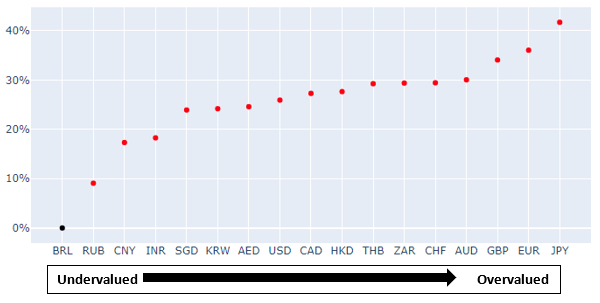
A basket of devices’ products (iPhone, MacBook, PS5, Xbox and Samsung Galaxy S21) costs ¥ 4,34,000 (Japanese Yen) in Japan, and R 90,000 (South African rand) in South Africa which is equivalent to ¥ 6,75,000.  A comparison across currencies is plotted below:

Observations:

The overall range reduced. Barring two currencies on right, the range is between 0 – 25%. This is because of two factors:

  1. Devices are manufactured globally and thus, the costs of production for these are almost same irrespective of the location it is sold in. Thus, while selling to customers companies want to charge standard margins across the globe.
  2. These goods have high value per weighing per unit, and can be transported from one location to anothe easily. If the price difference between two regions is too much, a third party seller might but a bulk of these goods in the cheaper location travel to the expensive location and sell to customers there, making a lot of money during the process. 

Software

A basket of software products (Adobe CC, Microsoft 365, Apple iCloud) will cost R$ 546 (Brazilian real) in Brazil, while in Japan it costs ¥ 21,285 (~ R$ 1100).  A comparison across currencies is plotted below:

Observations:

  1. The overall valuation range increased. This is because although goods (software) are centrally developed, the transferability of goods/services is not possible. A customer in Japan who needs a software will have to buy it in same country as distribution is managed locally as per the local laws.
  2. The prices are higher in developed economies (like Japan, US) as compared to poorer economies (like Russia, China). This is because these are high margin products, and the companies tend to lower their margin in poorer economies to lure customers and charge more to customers in developed economies with high affordability.

Content

A basket of content products (Netflix, Amazon Prime, Disney +, YouTube Premium, Spotify, Apple Music) costs ₹ 2,774 in India, on the other extreme it costs £ 114 (~ ₹ 11,500) in UK.  A comparison across currencies is plotted below:

Observations:

  1. The overall range increased, now ranging from 0-80%. To put it in another way based on prices of Content services like Netflix, Amazon, Spotify etc, the Great Britain Pound (GBP) is 80% overvalued as compared to Indian Rupee.
  2. Unlike products or software, a lot of digital content is produced locally. The Netflix and Amazon have production houses in many countries and produce movies/ TV Series in local languages. The budget for movies produced in Bollywood is a lot less than one produced in Hollywood. Such content may be globally but the target audience in most of these cases are local customers. Benefits of these lower costs are passed onto customers by charging lower prices.
  3. Market forces also brings down the prices. A blockbuster movie in India might attract more eyeballs than a blockbuster in USA, but the former would earn a lot less due to price sensitive customers. Thus, companies must limit the prices they can charge on content.

Summary

PPP dictates that the prices of commodities should be same all over the world. If the prices are different, some currencies are either overvalued or undervalued. But as we saw in our comparison of the prices of different category of products, there might be other reasons for the price’s disparity. Products with high value per weight are prone to be physically traded and are more likely to have similar prices in the countries they are available in. Next, products having same cost of production are more likely to be priced similar, as companies need to recoup their investments. Finally, in products where cost of production is different, companies have more flexibility to vary their prices and thus, there is maximum price disparity among these.

When we think of lower cost of production, we assume that it is due to availability of cheaper labour. The assumption is not entirely correct. The bifurcation of traded cost and non-traded cost has a better explanation. That would be a great idea for a new post 😉

Annexure

  • Devices
    1. iPhone 12 – 64 GB
    2. Macbook Air – Apple M1 Chip with 8‑Core CPU and 7‑Core GPU 256GB Storage
    3. Play Station 5 – Disk Version
    4. XBOX Series X
    5. Samsung Galaxy S21 Ultra – 5G, 256 GB, 12GB
  • Software
    1. Adobe CC Subscription- Adobe CC All Apps Annual Plan Monthly Payment
    2. Microsoft 365 Subscription – Microsoft 365 Personal Annual Plan
    3. Apple iCloud Subscription – 50GB Storage Monthly Plan
  • Content
    1. Netflix – Premium Plan per month
    2. Amazon Prime – monthly Subscription
    3. Disney + – Yearly Subscription
    4. YouTube Premium – YouTube Premium with YT music
    5. Spotify – Individual plan for 1 month
    6. Apple Music – Individual for 1 month

Detailed list of products and the prices as collected in February 2021 can be found here: https://cutt.ly/ppp_digital

Electoral College explained in Indian context

The US presidential elections concluded last year. Result: Joe Biden won 302 electors while Donald Trump won 232 electors. Joe Biden won by a margin of 13%. The vote count for Biden was 81 million and Trump received 74 million i.e., margin of seven million votes or just 5%. Why is the margin of victory different when both are results of the same election? It was even drastic in 2016 presidential election when Trump won by margin of 14% but surprisingly, it was Clinton who had more votes casted in her favour. Earlier in 2000 President George W. Bush won by a slight margin of 1% but his opponent Al Gore was the one with more vote count.

Why there were such anomalies?

Let us begin by understanding how does an Electoral College works. On the election day, a voter would go to the polling station and opt for the name of their preferred candidate and come back home. The candidate with the greatest number of votes wins. This is the simplest way to elect the president and is known as ‘popular vote’. In India that is not how we choose our Prime Minister. In India, each state is divided into constituency and can have multiple constituencies based on the population. Uttar Pradesh, for example has 80 constituencies. On the voting day voters vote for their preferred candidate in their constituency. The candidate with highest number of votes wins a seat in parliament and is referred as Member of Parliament (MP). These MPs from all constituencies then get together and vote for Prime Minister and party / coalition winning majority seats in parliament forms the government and gets to choose the Prime Minister.

Similarly, in US presidential elections, the voters do not directly vote for the President but instead they select delegates or electors for their district. Based on population, each state in US is divided in various districts formally referred as Congressional District akin to what we have in India as Lok Sabha Constituency. Most populated state California has 53 districts. The key difference in Indian general election and US presidential election is that in India states have no role to play, however in US, states follow a winner-takes-it-all approach. Total number of votes in each state is compiled and party / candidate with the greatest number of votes in the state wins all electors from that state. For example, in 2020 President Joe Biden won more votes than President Donald Trump in New York and thus won all 29 out of total 29 electors from that state. This is the cause for magnified margins. Joe Biden just by winning 1% extra votes led to a difference of 5% electors.

Electoral College system in Indian election

Let us examine the impact of Electoral College system in Indian election. The dashboard below has the results of Lok Sabha election in India from year 1998 to 2020. Results are summed up using three different counting system: 1) Electoral College, as followed in US presidential election; 2) Constituencies, as followed in Indian general election; and 3) Popular Vote, representing which candidate/party received most votes. Remember party or coalition having majority (50%) votes in second pie chart (Constituencies) has formed the government. First (Electoral College) and Third (Popular Votes) pie charts represent how the results would have been had we followed a different system. A further breakdown at state level is represented in the fourth and fifth charts. The fourth chart represents the number of constituencies won by a party in a selected state in comparison to number of votes fetched as represented in the fifth chart. Note that in the electoral college system, the party with maximum votes would have won all the electors in that state.

Exploring the dashboard:

In the 2019 elections, the BJP won 37% of the popular vote which led to victory on 56% of the seats and a clear majority to the government. If the electoral college system was followed, the victory margin would be even bigger with BJP winning 66% of seats. What led to this amplification of margin? Uttar Pradesh. If we look at Uttar Pradesh state elections for the same year, BJP won majority votes which means that as per EC it should have secured 80 seats but won only 62, thus the magnification. In the year 2014 too, BJP which secured 71 seats in the same state which would 80 as per the EC count. In fact, UP being the biggest state would have been the biggest cause of anomaly in case of EC system.

Let us see if you can find out other big battle ground states. Hint 1: This state would have played a major role in 2009 and 2004 elections in presence of Electoral College system. Hint 2: BJP had whitewashed its main opponent in this state in 2014 and 2019 elections. If you spot the key states, please mention them in the comments section.

Conclusion

The popular vote system although seems to be a simple and straightforward approach, it has a limitation that less populated areas will be ignored, and parties would focus their efforts only on densely populated areas to garner as many votes as possible.

Electoral College voting has a glaring limitation of magnification. The states with high competition due to presence of demographies with diverse political affiliation get all the campaigning focus. When the margin of votes becomes less, persuading even a small number of people to switch can make the difference in electors due to magnification. These states which alter their political affiliation every few years are known as swing states.

Selection of MP from each constituency maintains a balanced approach among the three. It ensures appropriate representation of less dense regions while at the same time respecting the choice of majority. This system has its limitations too. For instance, it is most susceptible to political gerrymandering which is altering the boundaries of constituencies in a way that election would favour a particular party.

How gerrymandering works and where it has been used in past would be a great idea for another post.